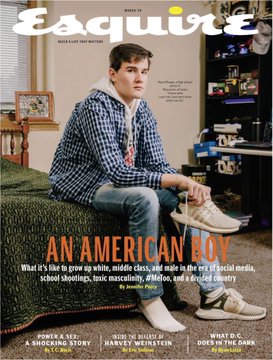
Esquire magazine just debuted its March 2019 issue, and the cover shines a spotlight on what it’s like for “an American boy” to grow up “...
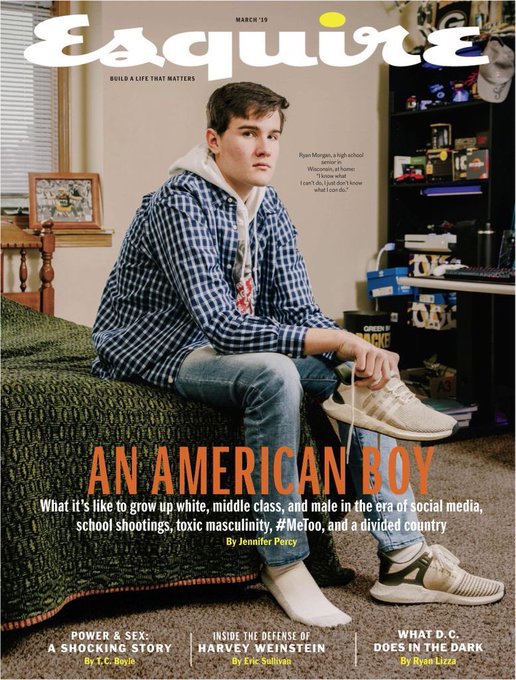
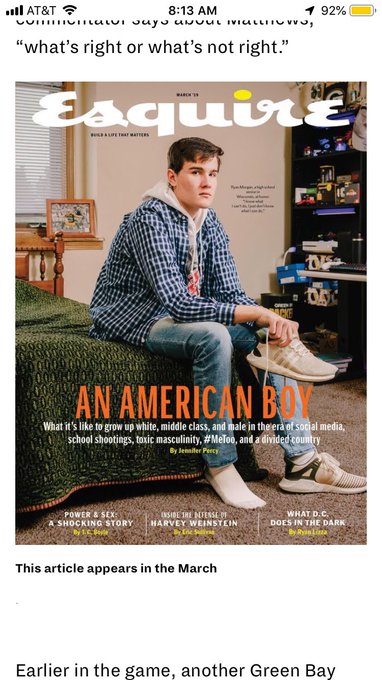
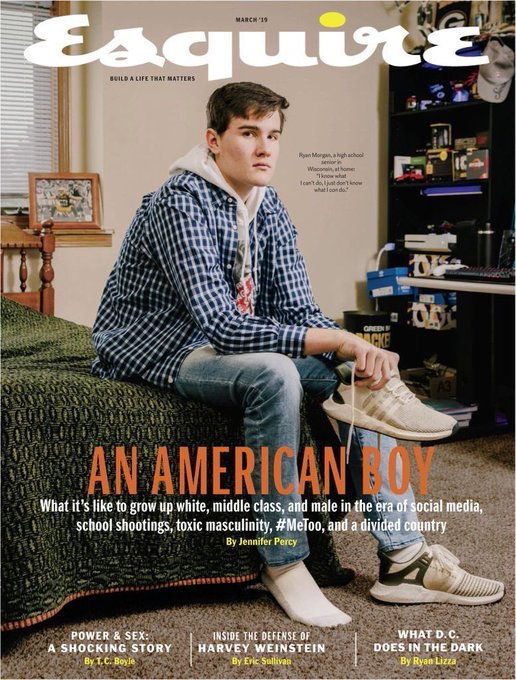
Esquire magazine just debuted its March 2019 issue, and the cover shines a spotlight on what it’s like for “an American boy” to grow up “white, middle class, and male in the era of social media, school shootings, toxic masculinity, #MeToo, and a divided country.”

But many people on Twitter are having none of it. Some could hardly believe the magazine seemed to be sympathizing with white male privilege in such a fraught cultural and political climate.
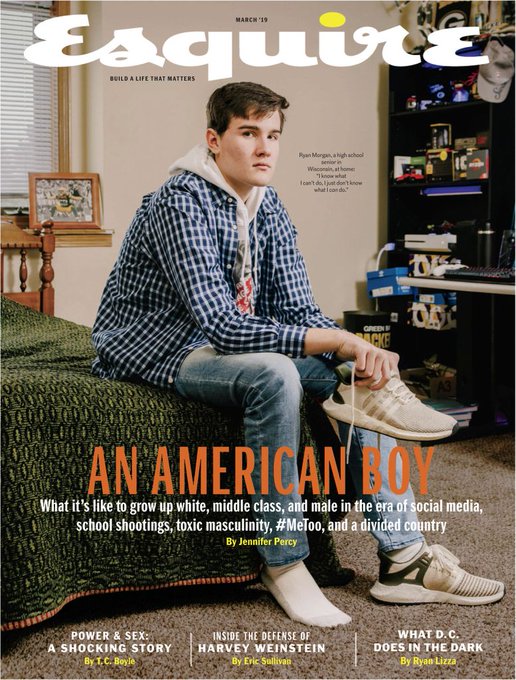
 how ! is!! this!!!! real!!!!!!!!!!!!! pic.twitter.com/r3BljOWJEQ





A few immediately picked up on the insensitive timing of the issue’s release — the second week of February, which is Black History Month.




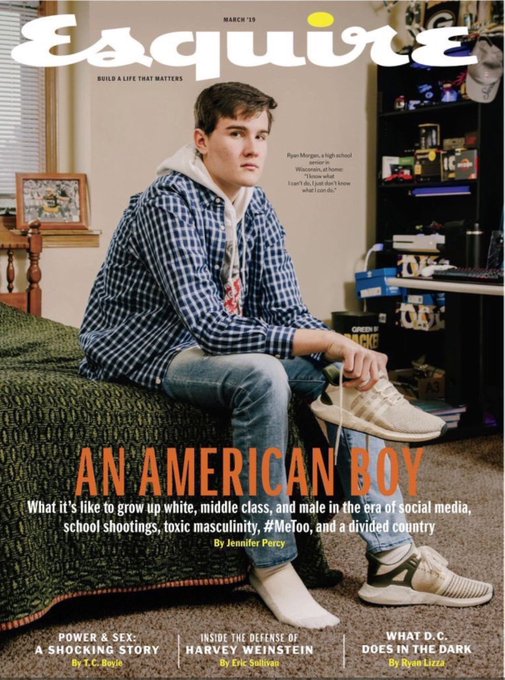
I do not mind that there exists an article somewhere in the world about young white boys of privilege needing to relearn about masculinity. I do mind that it’s on the cover of @esquire during Black History Month.

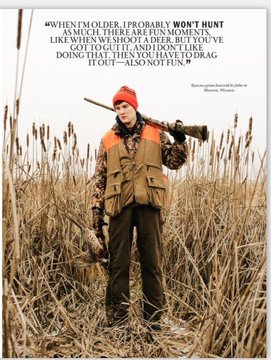
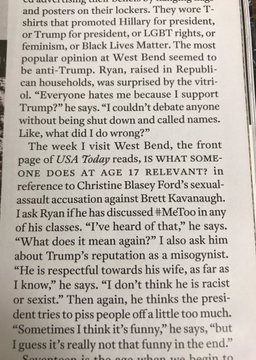
The cover accompanies a feature story that’s the first installment in a “new series about a boy,” according to Esquire. It profiles 17-year-old Ryan Morgan, from West Bend, Wis. Some feel one feature on the “plight” of white males is bad enough, and an entire series just adds insult to injury. Others are baffled by the subject matter.
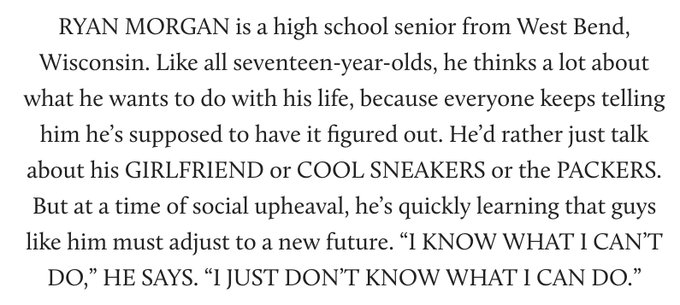
Totally baffled by this 7,000+ word Esquire cover story about a run-of-the-mill Republican teen who likes "COOL SNEAKERS" classic.esquire.com/article/2019/3…

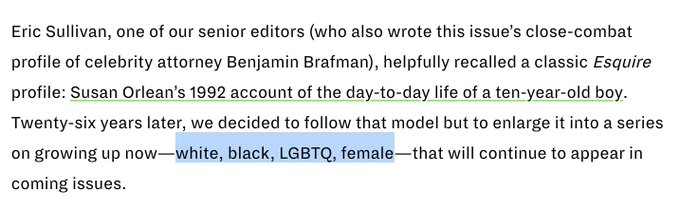
It is extremely telling that, while the esquire editor’s note mentions that non-white, non-male children will be profiled eventually, it’s the white boy who gets the cover and the first story esquire.com/news-politics/…



Some are flat-out angry about the feature, and no one is being shy about why.


Way to go @esquire. This is the most stunning display of Trump-supporting white male cishet victimhood I’ve read in ages.

Imagine the influence Esquire could've had by covering the experience of a 17 year old Black youth, preferably queer or trans. There is no justifying covering the plight of the white cishet male of any age. We're overexposed to it and often fall victim or prey.








I don't understand why white women always have a problem with white men, THEY REARED THEM TO BE THAT WAY AND DON'T TAKE RESPONSIBILITY FOR WHAT THEY HAVE DONE! Don't like the outcome, change the way you rear them!!!! Simple....
ReplyDeleteYou want history?
ReplyDeleteKONDA The Konda were among the most proficient and brutal of slavers. Description of a Konda sword --- Form specifically used for the capture of slaves for their human consumption (cannibalism) market. The Konda provided slaves for the Arab market as well as for domestic consumption, which was described by Glave in 1890. This weapon served in the confined quarters where captives were subdued and gathered. It served to control, disable and kill the victims while preserving the marketable corpse.
NGOMBE/POTO --- The Ngombe melded with the Poto who themselves were displaced and assimilated into the Bantu culture. As with all Congolese slavers, their weapons were designed for effective use in close quarters and later, used for dismemberment of slaves slaughtered for human consumption.
MANDINGO --- the period of the transatlantic slave trade of which Gambia and the Mandingo were pivotal elements. Since contact with the Portuguese in the 18th century and subsequently the British, the Mandingo supplied a steady stream of slaves for the North American and South American markets. It was the Mandingo from which Alex Haley drew his main character for now largely discredited "Roots" .
TETELA --- the late slave trade period which supplied the markets for the Arab world and South America. In this period, there were just two commodities produced in Africa, ivory and slaves, of whom millions were exported. The Tetela were slavers who used a variety of weapons depending on the situation. Shorter weapons served battle at close quarters as in the hut or kral with spears and sword used on the battle field. Once subdued, the adversaries were sorted for usefulness and saleablilty with fit men and women sent to market, and young men sometimes introduced into the ranks of the slavers. The old, infirm and wounded were executed. The Tetela were considered the most vicious and most feared of Congolese slavers. They were savage in their attacks which included tribal war for the purpose of slave captures. During the second half of the 19th century, tribal wars were specifically for the capture of slaves and not territorial.
YAKA (Congo) ---- The Yaka were ferocious warriors. They were slavers and likewise preyed on by their neighbors.
ASHANTI --- Slave raiding was all hand to hand combat often within confines of the hut or kral. The weapons needed were necessarily short. The Ashanti traded slaves and ivory with the English and Portuguese.
Same with thoer daughters whose heads are full of poop.
ReplyDeleteTo all the losers who negatively commented on this article, piss off. The whole world has been bending over backwards so your weak minds don't freak out over the smallest perceived offense. Grow up. It's OK to be white, we don't need your permission to be ourselves and thrive. Our culture is just as important as yours. If you don't like it, leave.
ReplyDelete